Understanding SEO Optimization for Website Success
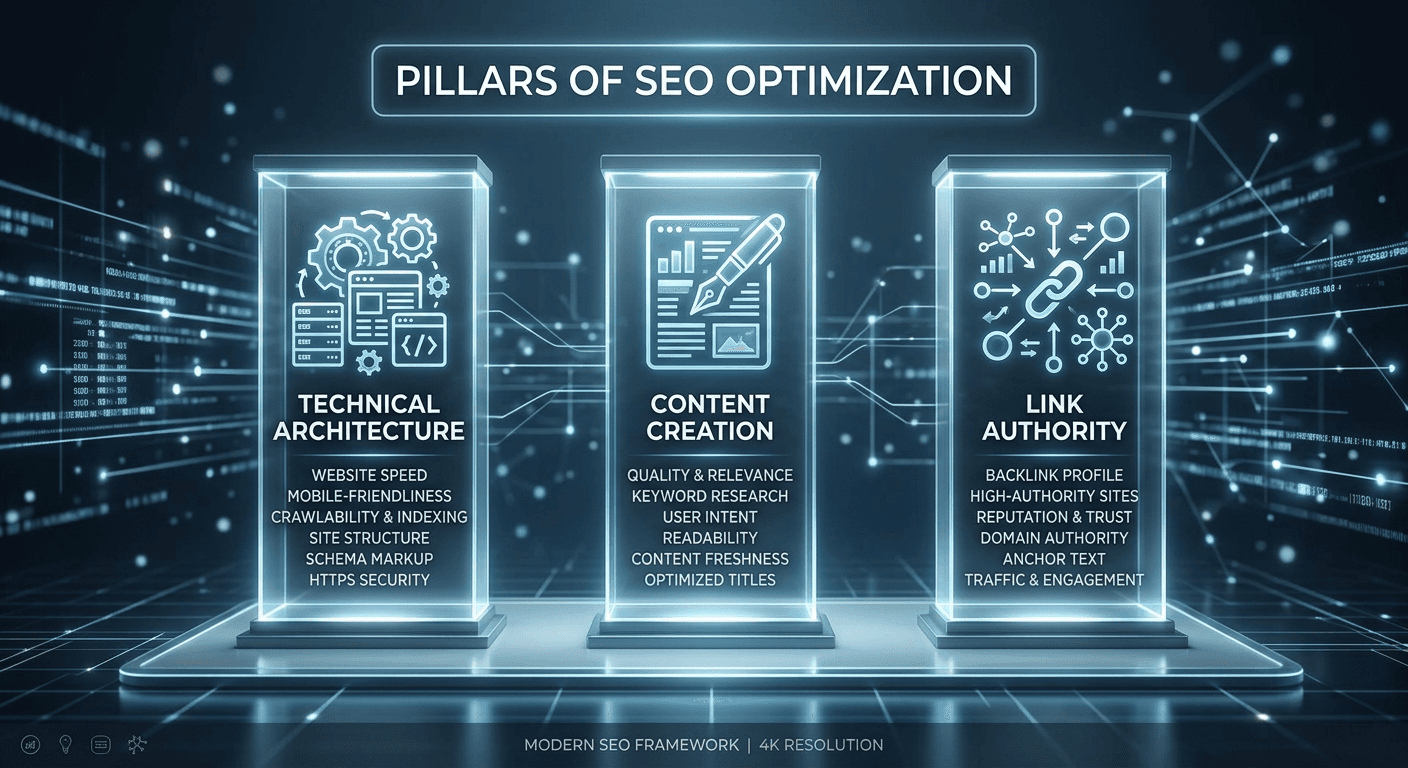
SEO optimization for website success is a multi-layered discipline that demands a rigorous balance of technical architecture, content relevance, and user experience signals. By aligning your digital infrastructure with the complex algorithms of modern search engines, you transform a standard web page into a high-authority asset capable of capturing sustained organic traffic. This process goes beyond keywords, focusing instead on intent-driven indexing and semantic authority.

Quick Summary {#quick-summary}
SEO optimization for website health involves the systematic improvement of technical, content, and authority signals to achieve higher rankings on search engine results pages (SERPs). Effective strategy focuses on crawling efficiency, user intent fulfillment, and building a reputable domain profile to ensure long-term visibility in competitive digital environments.
- Technical SEO ensures crawlers can access and interpret your site data without friction.
- Content relevance aligns page topics with specific user search queries.
- Authority building through internal linking and high-quality external citations.
- Mobile-first responsiveness is a non-negotiable ranking factor for modern platforms.
Table of Contents {#table-of-contents}
- Quick Summary
- Fundamentals of SEO Optimization for Website Architecture
- Technical SEO: The Bedrock of Search Engine Performance
- Content Strategy and Intent-Based SEO for Website Success
- On-Page Optimization and Semantic Authority
- Measuring SEO Success Through Data Analysis
- Common SEO Pitfalls and How to Avoid Them
- FAQ: Frequently Asked Questions
- Recommended Reads
Fundamentals of SEO Optimization for Website Architecture {#fundamentals-of-seo-optimization-for-website-architecture}
At the core of any successful digital strategy lies the architecture of the site. If search engines cannot efficiently crawl and index your pages, no amount of quality content will compensate for the deficit. A flat site structure, where key pages are no more than three clicks away from the homepage, remains the gold standard. This allows link equity - the "juice" that boosts rankings - to flow logically through your internal hierarchy.
Furthermore, site speed and core web vitals have evolved from optional metrics to critical ranking factors. Optimizing for website speed involves minimizing server response times, compressing heavy assets, and ensuring that your hosting environment is capable of handling concurrent requests. By reviewing your <a href="https://rapidwombat.eu.com">technical deployment</a> and cleaning up legacy code, you provide the foundational stability required for search engine bots to perform their tasks without timing out or missing updates.
Technical SEO: The Bedrock of Search Engine Performance {#technical-seo-the-bedrock-of-search-engine-performance}
Technical optimization is the mechanical side of SEO for a site. This encompasses XML sitemaps, robots.txt configuration, and the implementation of structured data (Schema markup). Structured data allows search engines to better understand the entity represented on a page, potentially rewarding you with rich snippets that increase click-through rates. If your implementation of these elements is flawed, you effectively hide content from the very systems intended to find it.
The Role of HTTPS and Security
Security is a fundamental signal for Google. Migrating to HTTPS is no longer a suggestion; it is a baseline expectation. Beyond simple encryption, modern SEO optimization for a website includes managing security headers and preventing mixed-content warnings. When you prioritize site security, you are not just protecting user data, but also demonstrating the trustworthiness of your platform to search algorithms.
Pro Tip: Always utilize canonical tags to prevent duplicate content issues when you have multiple URLs pointing to similar or identical content versions. This ensures that your ranking signals remain consolidated on a single, authoritative page.
Content Strategy and Intent-Based SEO for Website Success {#content-strategy-and-intent-based-seo-for-website-success}
Content is the primary bridge between a user's problem and your solution. Modern search algorithms rely heavily on E-E-A-T (Experience, Expertise, Authoritativeness, and Trustworthiness). To optimize for this, content creators must move away from keyword stuffing and toward comprehensive, topic-cluster approaches. By creating a 'pillar page' supported by deeper, thematic 'cluster' articles, you demonstrate topical authority that captures a broader range of semantic variations.
Intent-based optimization requires deep analysis of what the user is actually looking for. A keyword like 'web design' could represent someone wanting to hire a firm, a student learning the skill, or a developer seeking inspiration. Creating content that addresses the user's specific stage in the journey—whether informational, navigational, or transactional—significantly improves engagement metrics like dwell time and bounce rate, which are indirect indicators of quality for search engines.
On-Page Optimization and Semantic Authority {#on-page-optimization-and-semantic-authority}
On-page efforts center on the elements within your control on a specific web page. This starts with optimized meta titles and descriptions that provide clear, compelling context for the reader. However, the most critical on-page factor is the logical use of HTML heading tags (H1 through H6) to create a clear document outline. This structure guides the reader and assists search crawlers in discerning the most important topics within the page.
| Feature | Impact Level | Strategy Focus |
|---|---|---|
| Page Speed | Very High | Assets and Server Response |
| Internal Linking | High | Hierarchical Flow |
| Schema Markup | Medium | Search Understanding |
| Meta Descriptions | Low-Medium | CTR Optimization |
Internal linking is a highly undervalued aspect of on-page optimization. By strategically linking your <a href="https://rapidwombat.eu.com/terms">service terms</a> or related product articles, you create a cohesive web of information. This encourages users to explore deeper into your ecosystem, keeping them on the site longer while signaling to search engines that your various pages are contextually connected.
Measuring SEO Success Through Data Analysis {#measuring-seo-success-through-data-analysis}
Effective SEO optimization for website growth relies on consistent feedback loops. You must track key performance indicators (KPIs) such as organic search traffic, keyword ranking progression, and conversion rates by channel. Simply monitoring traffic is insufficient; you need to understand which pages are driving high-quality leads and which are underperforming in terms of user engagement.
Use tools like Google Search Console to monitor indexing errors and impression data. If you notice a high volume of impressions but a low click-through rate, your meta-data may need optimization. If you see high bounce rates on critical landing pages, your content is likely failing to meet the user's intent. Continuous refinement based on hard data is what separates amateur attempts from professional search engine management.
Common SEO Pitfalls and How to Avoid Them {#common-seo-pitfalls-and-how-to-avoid-them}
One of the most frequent mistakes in SEO for a site is the neglect of mobile optimization. Since Google uses mobile-first indexing, any deviation in content or functionality between desktop and mobile versions can lead to ranking volatility. Ensure that your mobile user interface is as functional as the desktop version, with no hidden content or bloated, non-responsive scripts that degrade the experience.
Another significant pitfall is the misuse of 'noindex' tags or overly restrictive robots.txt files. It is surprisingly common for websites to launch with critical sections accidentally blocked from crawling. Always test your site structure in a staging environment before pushing changes to production, and never assume that 'set it and forget it' applies to SEO settings. Your <a href="https://rapidwombat.eu.com/privacy">privacy policies</a> and other essential pages should always be accessible to search engines, even if they aren't the primary focus of your traffic strategy.
FAQ: Frequently Asked Questions {#faq-frequently-asked-questions}
-
How long does it take for SEO optimization to show results? SEO is a long-term investment. Most significant ranking shifts occur over three to six months, depending on your industry's competitiveness and your current domain authority.
-
Is social media a direct ranking factor? Social media is not a direct ranking factor in the same way backlinks are, but it indirectly helps by driving traffic and increasing visibility, which can lead to earned natural backlinks.
-
Do I need to update my content regularly? Yes. Search engines prefer fresh content. Updating existing pages with current statistics, updated examples, or improved readability can significantly improve rankings.
-
What is the most important part of SEO for a website? Quality content that fulfills user intent is paramount. Technical SEO provides the access, but content provides the reason for the user to be there and the search engine to index the page.