Technical Steps to Fix a Declining SEO Ranking Site in 2026
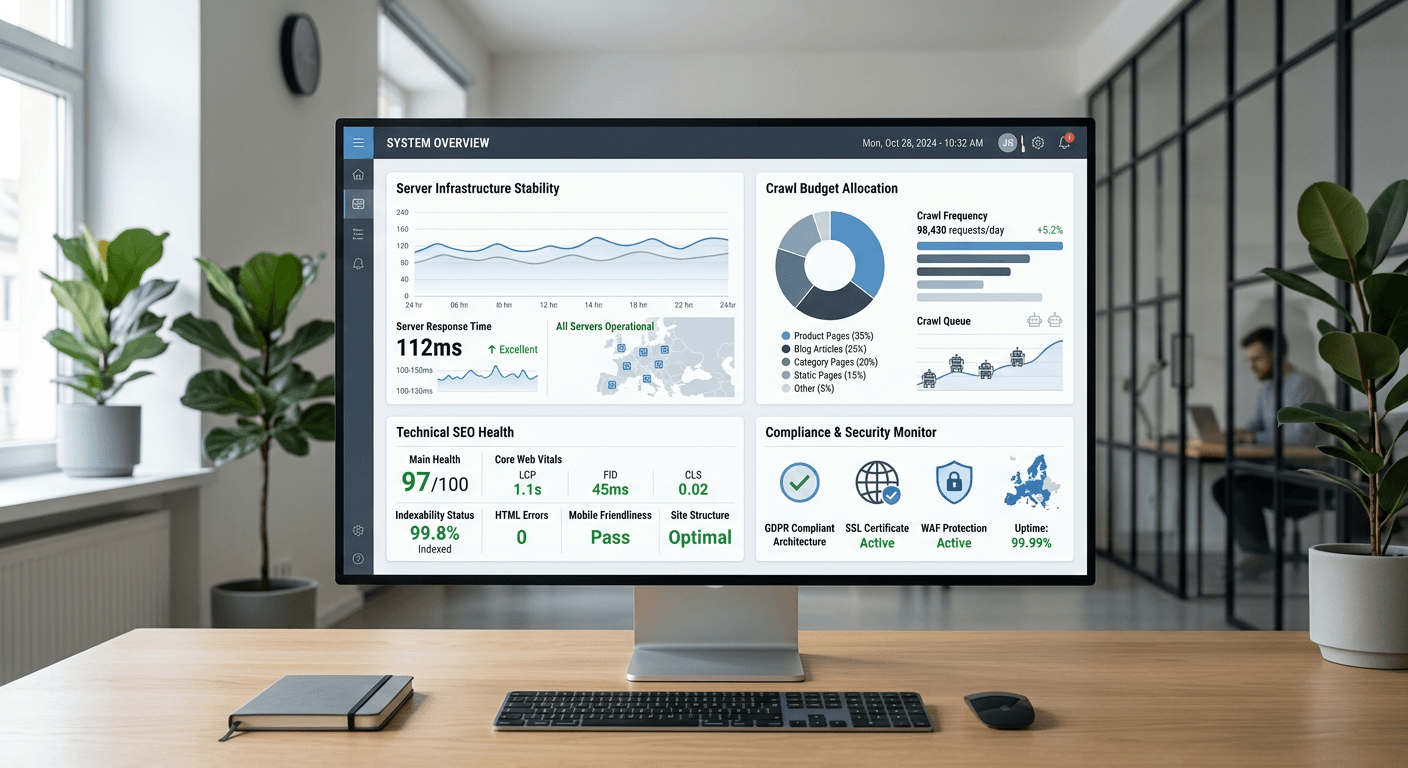
Most engineering and marketing teams treat technical search optimization as a launch requirement. They migrate the domain, configure the initial caching layer, submit the XML sitemap, and assume the architecture is settled indefinitely. Six months later, the crawl budget is exhausted by generated parameter URLs, server response times have drifted upwards due to database bloat, and overall indexation drops. Building a resilient seo ranking site requires treating technical health as a continuous metabolic rate rather than a static baseline. When search engine bots hit an infrastructure that responds slowly or serves conflicting indexation directives, they reduce crawl frequency to protect user experience, effectively stranding your newest, most valuable content. The reality is that algorithms do not just evaluate the words on the page; they evaluate the friction required to extract those words.
Why a static seo ranking site decays internally
Search engines measure infrastructure reliability as strictly as they measure content relevance. A static architecture decays because the web environment surrounding it changes constantly. Core CMS plugins push background updates, database tables fragment and expand, new category creations generate unexpected duplicate URL paths, and third-party tracking scripts choke the browser's main thread. When you stop monitoring these technical signals, you lose control over how search engines perceive your domain's stability.
We see this acutely in European markets where mandatory data compliance scripts often introduce severe render-blocking delays if they are not correctly asynchronous or configured through an enterprise tag manager. Every additional consent banner or localized tracking script adds network requests that delay the document interactive status. Your baseline infrastructure must be designed to self-correct or, at minimum, trigger alerts when raw response times cross acceptable thresholds. For teams managing complex regional deployments, adopting an AI-driven SEO for European businesses ensures that technical compliance scales alongside content production without bottlenecking crawler access.
Quick Summary
Technical SEO is the ongoing operational process of maintaining server efficiency, optimizing crawl budget allocation, and resolving structural decay to ensure search engines can index and rank your content without friction. Failing to monitor these components actively results in systemic ranking drops across the entire domain.
- Server response times (TTFB) must consistently stay under 150ms to maintain optimal crawl rates.
- Crawl waste from parameter URLs must be blocked at the network level via robots.txt.
- Internal link equity requires active management to prevent deep silos and orphan pages.
- Automated uptime monitoring prevents temporary server outages from causing permanent de-indexations.
Table of Contents
- Why a static seo ranking site decays internally
- 1. Audit your server response times and caching layers
- 2. Restructure indexation to eliminate crawl waste
- 3. Map and repair the internal link equity decay
- 4. Implement automated uptime and security monitoring
- 5. Standardize your schema markup for entity recognition
- Common Pitfalls & Troubleshooting
- FAQ
1. Audit your server response times and caching layers
Search engines assign a specific crawl budget to your domain based on its historical reliability, server capacity, and inbound link popularity. The foundational metric dictating how much of your site gets crawled during a given visit is Time to First Byte (TTFB). This metric tracks the milliseconds it takes for the server to process an HTTP request, execute the necessary database queries, and return the very first byte of HTML to the client. If your server takes 800ms to respond, search engine bots will automatically throttle their request rate, fearing they might crash your infrastructure. This means your newest content goes undiscovered, and your existing ranking seo website architecture stagnates.
To fix this, you must analyze the three distinct phases of TTFB. They are DNS lookup time, SSL handshake duration, and raw server processing time. You need to configure aggressive server-side caching frameworks. Use Redis or Memcached for database queries. Next, route traffic through a Content Delivery Network (CDN). The CDN serves static assets directly from edge locations nearest to the search engine crawlers. You are aiming for a raw server response time of under 150ms globally.
The most common mistake teams make is confusing frontend performance metrics with backend responsiveness. Developers often spend weeks optimizing modern image formats to improve Largest Contentful Paint (LCP) but completely ignore the unindexed database queries slowing down the initial HTML document delivery. If the server is slow to generate the Document Object Model (DOM), compressing images will not save your crawl rate. You must audit your raw server access logs to isolate whether the delay is happening at the database query level, the application logic level, or the network layer.
2. Restructure indexation to eliminate crawl waste
Crawl waste occurs when search engine bots spend their allocated daily time on your domain requesting low-value or duplicative URLs, such as faceted navigation parameters, internal search results, session IDs, or dynamically generated tag pages. When bots waste computational resources traversing these infinite spaces, they miss your high-value commercial product pages and informational hubs. Controlling this URL flow precisely is how you build a resilient web site ranking google actively trusts and crawls deeply.
The mechanics involve enforcing a strict division of labor between your robots.txt file and your meta robots HTML tags. The robots.txt file acts as a barrier at the network layer; it prevents the crawling process entirely, conserving budget. Meta robots tags (specifically noindex) permit the crawl but instruct the search engine not to store the page in its database. You must map every parameter your CMS generates - such as specific price sorts, color filters, or session tracking IDs - and explicitly block them via robots.txt if they do not provide a unique, search-demand-driven experience for a user.
The defining mistake practitioners make in this step is using canonical tags as a bandage for massive crawl waste. A canonical tag is merely a ranking hint. It indicates which version of a duplicate page should hold the equity. It does not stop the search engine bot. The bot still requests and crawls the duplicate page to read that tag. If your CMS generates fifty thousand parameter variations and you only canonicalize them to the parent category, search engines will still download all fifty thousand URLs. This burns your crawl budget entirely. Search engines ignore your actual target pages.
3. Map and repair the internal link equity decay
Internal linking is the structural mechanism that distributes link equity from your highly authoritative pages - usually the homepage and core resource hubs that attract external backlinks - down to deeper, highly specific product or article pages. Over time, as a content site grows, this architecture naturally decays. Old pages get buried under new paginated archives, creating deep, isolated silos that search engine bots struggle to reach efficiently. A strong site ranking relies on a shallow click depth where every critical commercial page is accessible within a maximum of three clicks from the root domain.
To repair this structural decay, you must run a comprehensive site crawl using a desktop crawler or cloud-based auditing tool that maps the entire internal link graph. Identify orphan pages - pages that exist in the sitemap but have zero contextual internal links pointing to them - and systematically integrate them back into relevant topical hubs.
Practical rule: Never rely on native pagination to pass critical link equity; build dedicated, topically grouped hub pages that link directly to your most important revenue-generating assets.
The standard failure mode here is outsourcing your internal linking strategy entirely to automated related posts plugins or dynamic recommendation engines. These plugins often randomize their output on every single page load based on user behavior, which means the internal link graph changes every time a search engine bot visits. This creates a highly volatile architecture where pages randomly gain and lose authority week over week, leading to erratic ranking fluctuations. You must establish static, hard-coded internal links within the main body content of your highest-authority pages.
4. Implement automated uptime and security monitoring
Search engines actively penalize domains that exhibit chronic instability. If a crawler encounters a 500 Internal Server Error, a 502 Bad Gateway, or a 503 Service Unavailable status over consecutive visits, it will systematically drop those URLs from the index to protect their users from broken experiences. A reliable web ranking is mathematically impossible to maintain if your hosting infrastructure drops database connections during peak traffic hours or scheduled backend backups.
The mechanics of this step require implementing synthetic monitoring that pings your critical pages every single minute. This monitoring must check not just for a basic 200 OK HTTP status, but verify that specific structural HTML elements render correctly. Security monitoring must run concurrently, scanning the source code for unauthorized changes to the DOM, expired SSL certificates, or injected malicious scripts - which search engines detect quickly and punish severely with browser-level blocklist warnings.
The critical mistake engineering teams make is configuring basic uptime monitors from a single geographic region, usually located in the same data center as their origin server. For a European business serving multiple cross-border markets, local latency issues, regional CDN node misconfigurations, or country-specific firewall blocks will go entirely unnoticed. If French users and local search nodes are experiencing network timeouts while the monitor reports perfect health from a German data center, your rankings in France will collapse silently. You must monitor uptime and response codes from synthetic nodes distributed across all your target markets.
5. Standardize your schema markup for entity recognition
Modern search operates on graph-based entity recognition rather than mere text string matching. Search engines need to definitively understand the relationships between the corporate organization publishing the content, the specific authors writing it, and the objective topics being discussed on the page. Standardizing your schema markup is how you feed this knowledge graph directly, securing higher web seo rankings by removing all algorithmic ambiguity about what your pages represent and who stands behind them.
You must deploy structured data using the JSON-LD format, consolidating your Organization, WebSite, Article, and BreadcrumbList declarations into a cohesive, single-script output. For teams looking to rank seo website properties efficiently across fragmented markets, this means explicitly defining your corporate entity with its verified registration numbers, linking it to your verified social profiles, and explicitly tagging localized business data for your target regions.
The fatal error practitioners commit is allowing multiple disparate CMS plugins to inject fragmented, conflicting schema blocks on the same URL. When an SEO plugin declares the page an Article, a separate review plugin declares it a Product, and the core theme injects an empty WebPage schema, search engines discard the data entirely due to validation conflicts and missing required fields. You must disable automated theme-level schema generation and centralize your entire JSON-LD deployment through a dedicated script manager or a rigorously tested custom implementation.
Common Pitfalls & Troubleshooting
When a site begins to lose visibility, the symptoms often overlap. Diagnosing the precise failure requires isolating variables rather than guessing. Here are four distinct technical failures that look identical on a traffic chart but require entirely different fixes. The first listed is most often the real cause of a sudden traffic drop.
1. Unintentional Indexation Blocks (Most Common Cause) Symptom: Traffic drops sharply across the entire domain within a matter of days, yet the site remains perfectly functional and fast for human users. Diagnosis & Fix: This usually stems from a botched deployment where a staging environment's restrictions leaked into production. Check your HTTP headers for an injected noindex tag and verify your robots.txt file for a blanket disallow rule. The fix is strictly administrative: remove the blocking directives from the server configuration and submit the homepage to Google Search Console for immediate recrawling.
2. Soft 404 Epidemics Symptom: Individual category pages or product listings slowly bleed traffic over months, and Search Console reports a steady, uninterrupted rise in excluded pages. Diagnosis & Fix: The server is returning a 200 OK status code, but the page content is completely empty, out of stock, or fundamentally broken. Search engines label this a Soft 404 and intentionally drop it from the index. To fix this, you must configure your server to return a hard 404 or 410 status code for genuinely deleted pages, or implement 301 redirects to the nearest relevant parent category.
3. JavaScript Rendering Failures Symptom: The raw HTML source code is incredibly thin, and the core content only appears after the DOM fully loads, resulting in zero search impressions for text that is visibly present on the screen. Diagnosis & Fix: Your core content relies exclusively on client-side JavaScript execution, and search engines are hitting their render timeouts before the text actually populates. Check how the page looks with JavaScript disabled in your browser. The fix requires moving to server-side rendering (SSR) or dynamic rendering, ensuring the raw HTML document contains the critical text payloads immediately upon request.
4. Canonical Chain Loops Symptom: Search engines swap which version of a page ranks on a weekly basis, leading to highly volatile, unpredictable ranking positions for core keywords. Diagnosis & Fix: You have implemented canonical tags that point to URL A, but URL A points to URL B, or URL A dynamically redirects back to itself. This conflicting signal causes search engines to ignore the canonical tags entirely and guess. Map your canonical instructions with a crawler and ensure every duplicate URL points directly to the final, 200-status primary page without chains or redirects in between.
FAQ
How often should I run a technical site audit?
A comprehensive technical audit should be conducted quarterly, but critical infrastructure metrics - such as server uptime, TTFB, and robots.txt file changes - require continuous, automated daily monitoring. Manual quarterly audits catch long-term architectural drift, while automated daily checks prevent immediate, catastrophic de-indexation events.
Does migrating hosting providers affect rankings?
It certainly can, if executed poorly. A change in hosting inherently alters your server IP address and baseline response times. If the new server is demonstrably slower, or if DNS propagation causes temporary downtime during the migration, search engines will throttle their crawl rate. To prevent this, ensure the new environment is fully stress-tested and run both servers concurrently until DNS propagation is globally complete.
Why are my newly published pages not being indexed?
The most frequent culprit is a depleted crawl budget caused by poor site architecture or excessive, uncapped parameter URLs. If search engines spend their entire allocated time crawling low-value duplicate pages, they will simply not discover your new content. Alternatively, the new pages might entirely lack internal links from established, high-authority hubs on your domain, effectively stranding them as unreachable orphan pages.
What is the difference between crawling and indexing?
Crawling is the mechanical process of search engine bots requesting and downloading the raw files from your server to discover structural links and content. Indexing is the subsequent algorithmic process of analyzing that downloaded content, understanding its entities, and storing it in the master database to be retrieved for relevant search queries. A page can be successfully crawled but refused indexation if it lacks unique quality or heavily duplicates existing content.